Worried you’re getting screen time wrong? Screen time guidelines by age run from almost none for babies, to about an hour a day for preschoolers, to quality-over-quantity for teens.
This guide is one part of the wider topic of digital parenting, which covers how families handle devices at every stage.
| Age or situation | Guidance |
|---|---|
| Under 2 years | Not recommended, except video chatting with caring adults |
| Ages 2 to 5 years | About an hour or less per day of routine or sedentary screen use |
| Toddlers older than 18 months | No more than 1 hour of screen time per day |
| Infants (besides video chatting) | Occasional brief, high-quality videos |
| Before bedtime | Avoid screens for at least 1 hour |
These figures come from the Canadian Paediatric Society’s Caring for Kids handout and the American Academy of Pediatrics clinician Q&A. Figures can change, so check the sources before you rely on them.
Why a single number rarely fits every child
Parents often hope for one safe number of hours. The American Academy of Pediatrics (AAP) says there isn’t enough evidence behind specific limits, which is part of why it updated its media use recommendations in 2016, according to its screen time Q&A.
That Q&A was updated in 2025, and as of that update it does not give a set limit that applies to all children and teens. Instead it asks families to weigh the quality of what children do on screens, not only the minutes, as the same AAP page explains.
The old 2-hour rule has fallen out of favour too. HealthyChildren.org calls the 2-hour screen time limit advice from years past, and offers the 5 C’s media use guidance with age-based tips instead.
Younger children are the exception to the “no fixed limit” approach. For babies and preschoolers, paediatric groups do give time-based ceilings, as the next sections show.
Babies and toddlers: the strictest years
The AAP’s clinician guidance says the infant and toddler years are a time when screens have more risks than benefits. It also says children who build heavier viewing habits early tend to have more problematic habits as they grow, per its guidance for clinicians.
For children under 2 years old, the Canadian Paediatric Society (CPS) says screen use is not recommended because they do not learn from it. The exception is video chatting with caring adults, such as extended family, according to the CPS parent handout.
One reason is the transfer deficit. Infants who are 18 months old or younger struggle to transfer what they see on a screen to their real world, as the AAP clinician Q&A describes.
If you want a time figure, the same AAP guidance suggests occasional brief, high-quality videos such as Sesame Street for infants. It limits toddlers older than 18 months to no more than 1 hour of screen time per day (AAP).
The AAP also acknowledges that many families rely on screens at times, and it offers three realistic steps in place of an all-or-nothing rule:
- Choose high-quality educational media, for limited amounts of time.
- Talk with your child while the screen is on.
- Offer alternatives such as books or toys.
Background noise counts as well. The CPS handout advises turning screens off when no one is using them, especially background TV.
Preschoolers: about an hour is a ceiling
For children 2 to 5 years old, the CPS handout says to limit routine or sedentary screen use to about an hour or less per day. Treat that as a ceiling, not a target to reach.
It is a hard ceiling to meet. Only 15% of Canadian children aged 3 to 4 years meet a screen time guideline of under an hour a day, according to the CPS position statement. If your household is over, you are far from alone.
The CPS parent handout suggests a few everyday habits that make the limit easier to keep:
- Be a good role model with your own screen use on all devices.
- Turn off devices for mealtimes, reading together and family activities.
- Avoid screens for at least 1 hour before bedtime and keep them out of the bedroom.
- Make screen use something you do together, and talk about what you see.
School-age children and teens: from minutes to habits
For older children there is no single number to chase. The AAP says rules focused on balance, content, co-viewing and communication are associated with better well-being outcomes than rules focused on screen time, in its screen time Q&A.
A useful question is what screens are crowding out. The AAP suggests teens and caregivers check whether media use is pushing aside sleep or physical activity, and then crowd those activities back in, for example with a healthy bedtime routine or time outside.
Screen-free times and places help as well, such as family mealtimes. Teens can also change app settings to switch on nudges to take a break, add nighttime do-not-disturb settings and limit notifications, according to the same AAP source.
For platform-specific risks and conversations, read the guide to social media safety for teens.
Turning guidelines into a family plan
The 5 C’s of media use give you a checklist that works at any age, as HealthyChildren.org lays out. Ask yourself:
- Child: who is your child, and how does their personality shape what media attracts them?
- Content: content quality shapes whether kids have positive or negative relationships with media, so learn what they play and watch.
- Calm: if media has become the main way to settle strong emotions or fall asleep, talk to a pediatrician or other supports about alternatives.
- Crowding out: decide what your family wants back, such as quality time, more sleep or time outdoors.
- Communication: talk about media early and often.
Write your answers down in a family media plan so the rules are shared rather than argued about each evening. The AAP notes its own Family Media Plan can help families set these priorities together (AAP).
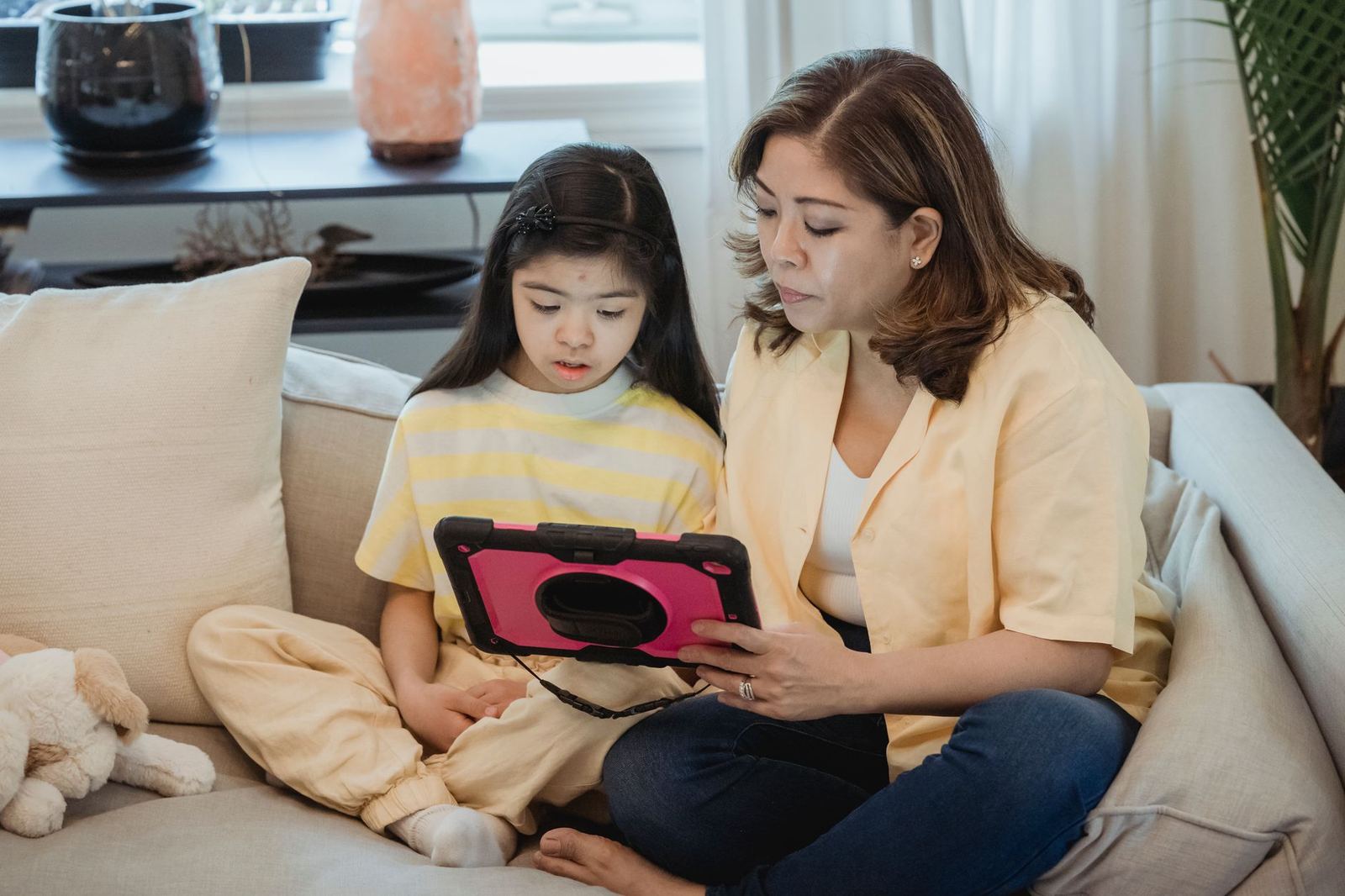
Expect pushback when screens go off. The CPS handout suggests using a calm voice, acknowledging your child’s frustration and redirecting their interest to another activity or toy.
Frequently asked questions
Is there a hard daily limit for teenagers?
Show answer
Not one that the AAP can back with evidence. Its Q&A says there isn’t enough evidence of a benefit from specific limits, so it points you toward what teens are doing on screens and how that fits around sleep and activity (AAP).
Can my baby watch anything at all?
Show answer
Video calls with relatives are the usual exception. If you do put something on, the AAP’s clinician guidance says to steer clear of low-quality platforms such as YouTube and to choose child-development-minded programming instead (AAP).
Is it okay to hand over a screen to calm my child?
Show answer
It can work in the moment, but the CPS warns that repeated use means your child may not learn to self-soothe without it. Calming strategies that don’t rely on a device build that skill (CPS).
Will my child fall behind without early exposure to technology?
Show answer
No. Canadian paediatricians found no evidence that starting young improves development, and say young children learn best from face-to-face time with caring adults (CPS).